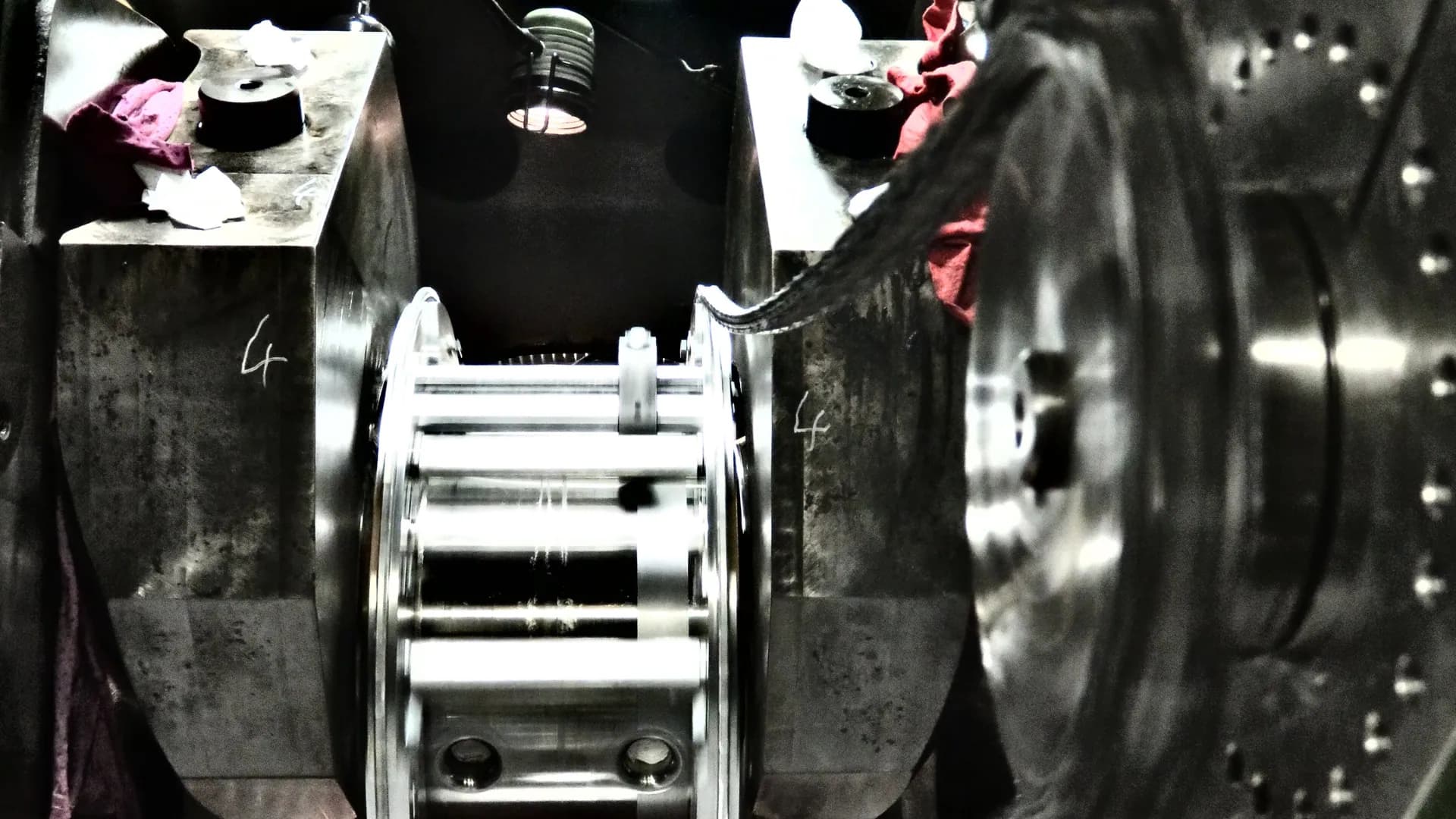
Crankshaft machining.
Assessment-led crankshaft work: condition and geometry established first, then the repair route that the findings actually support.
Establish the condition before choosing the repair.
A crankshaft repair should begin with an understanding of the damage, the available material allowance and the requirements for acceptance. Those findings decide the route: manual restoration within OEM wear limits, a workshop machining route, or a recommendation not to proceed. OSM connects the assessment and inspection to whichever route the condition supports.
Specialized tooling for full onsite crankshaft machining is in development and is not yet in service. Crankshaft damage assessment, inspection and manual restoration within OEM wear limits are available now; where full machining is required, OSM evaluates the workshop route.
Cam and ridge wear removal
Where the journal remains within OEM wear limits, manual, non-machining restoration uses custom-made precision tools. Protrusions are smoothed without unnecessary material removal or compromising journal geometry.
Related journal work
Related work includes fillet radius restoration, stress relief preparation, oil-hole chamfer and edge-break restoration, and journal diameter verification.
Verification after the work
Dimensional verification, surface finish analysis and material integrity testing support quality control after the work.
Potential scope.
- Crankshaft damage assessment, measurement and inspection.
- Manual cam and ridge wear removal where the journal remains within OEM wear limits.
- Evaluation of the available repair routes, including workshop machining.
- Assessment of geometry, access and portable tooling requirements.
- Defined inspection checkpoints and final dimensional verification.
The listed activities are a starting point for scope discussion, not a guarantee of suitability for a particular component.
What helps us evaluate the work.
- Engine make and model, journal location and available drawings.
- Known damage, measurements, inspection history and prior repairs.
- OEM limits, access arrangements and required stakeholder review.
Start with what you know.
Tell us the equipment, location and symptoms. Let us help define the next technical step.